
Ask a family where their wealth sits and the answer is usually a story rather than a spreadsheet; the business that grew, the land that appreciated, the shares that kept compounding, the property bought in the right city at the right time. Each of these decisions was sound. Taken together, they can leave a family dependent on one outcome.
That dependence is what wealth concentration risk describes: too much of a family’s financial future resting on a single asset, company, sector, geography, institution or person. The danger is not that any one holding is bad. It is that if it stumbles, nothing else in the balance sheet is positioned to absorb the blow.
What Concentration Looks Like Across India
At the household level, Indian wealth continues to remain heavily concentrated in physical assets. According to Kotak Mutual Fund’s September 2026 D-Kode report, real estate and gold together account for nearly 72% of total household assets as of March 2026, while equities account for just 5.7%. Among India’s wealthiest 1% of households, Bernstein estimates that nearly 60% of their assets are held in real estate and gold, highlighting the continued preference for traditional and physical assets.
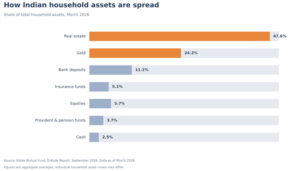
Aggregate averages, however, can mask the concentration of wealth within individual portfolios. Consider a business promoter whose wealth is largely tied to the company they own, a senior executive whose financial position depends on salary, ESOPs and employer-linked benefits, or a family whose assets are predominantly concentrated in real estate. Despite their different financial circumstances, each faces a common challenge: limited diversification across asset classes, geographies and sources of wealth.
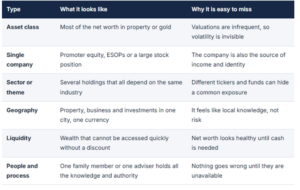
Six Ways Wealth Becomes Concentrated
Why Even Good Businesses Deserve a Second Look
A study of the US stocks from 1980 to 2014 found that around 40% of Russell 3000 companies suffered a decline of 70% or more from which they never recovered. Roughly two-thirds underperformed the index over their lifetimes, and about 74% of concentrated holders would have benefited from diversifying once volatility and the risk of permanent loss were counted. The data is American, but the lesson travels well: even strong businesses face disruption, and survivorship makes the winners look more typical than they are.
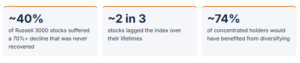
(Source: J.P. Morgan Asset Management, The Agony and the Ecstasy: The Risks and Rewards of a Concentrated Stock Position)
Five Questions to Assess Your Own Family
There is no universal percentage at which concentration becomes dangerous, because it depends on goals, income stability and time horizon. A more practical approach is to ask questions that expose it:
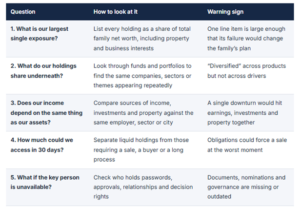
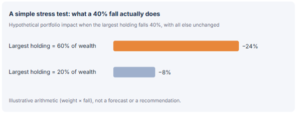
Running this exercise on your own largest holding, then on your two largest together, is often the fastest way to see whether the family is comfortable with the number it produces.
Reducing It Without Forcing a Sale
Concentrated positions carry more than financial weight. They carry embedded gains, sentiment and, sometimes, family expectations. A thoughtful reduction is therefore usually gradual rather than dramatic:
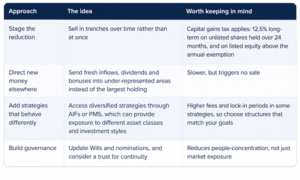
The goal is not to eliminate concentration, but to hold it knowingly, at a size the family has chosen.
Some of the most successful families built their wealth through concentration, and a promoter holding a stake in their own company is hardly a mistake. What matters is whether the exposure is a decision or simply an accumulation, and whether the rest of the balance sheet has been designed to support it.
A Fuller Picture Comes First
At InCred Wealth, this conversation begins with mapping the whole family balance sheet: every asset, every structure and every dependency, including those held outside the portfolio. Only then does it make sense to discuss what to hold, what to trim and what to protect. Seeing everything in one place is often the first moment concentration becomes visible.
Unlock Your Wealth’s True Potential