
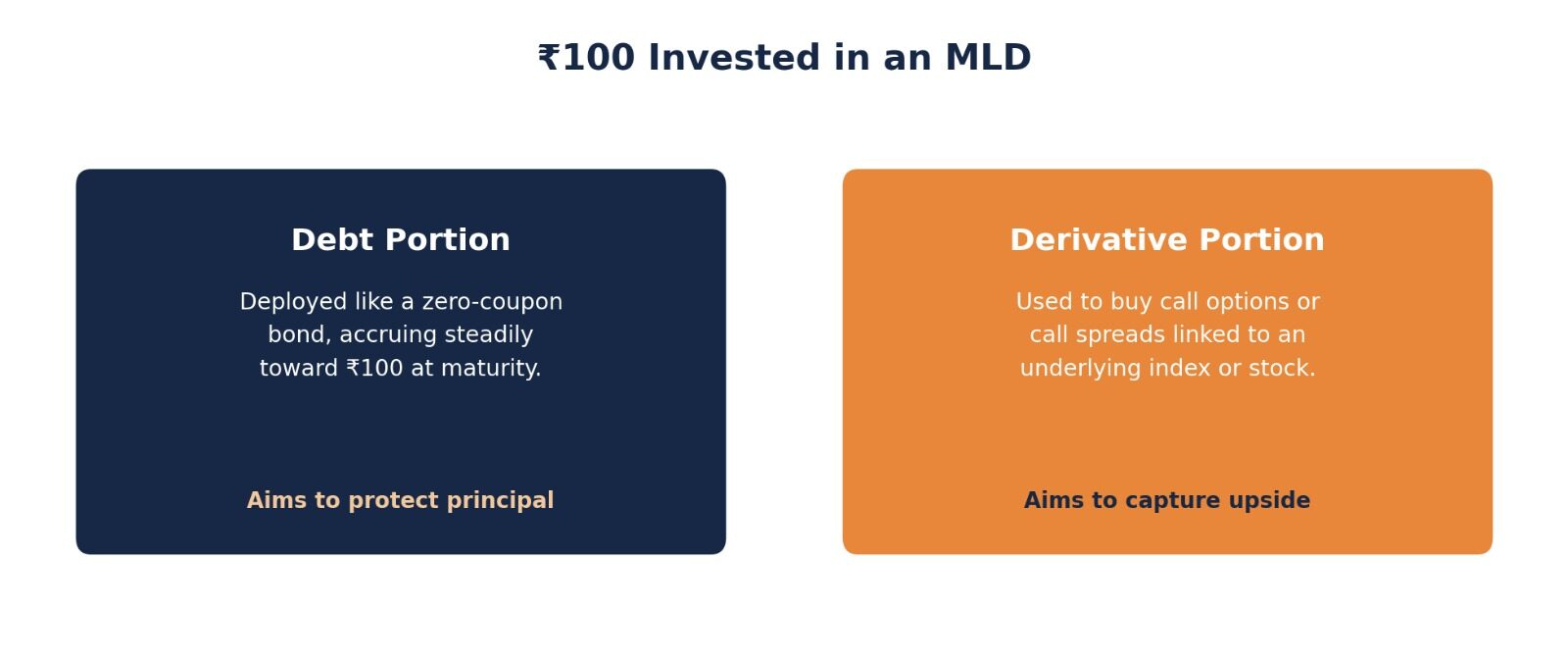
 The debt portion is deployed in fixed-income instruments or lending, accruing over time much like a zero-coupon bond, working to bring the investment back to its original value by maturity. This is what underpins an MLD’s principal-protection feature.
The derivative portion is used to buy call options or call spreads on the chosen underlying index or stock. This is the part of the structure designed to capture upside if the market performs well.
MLDs are often described as sitting between traditional debt and direct equity on the risk-return spectrum, offering a different risk-reward trade-off from either.
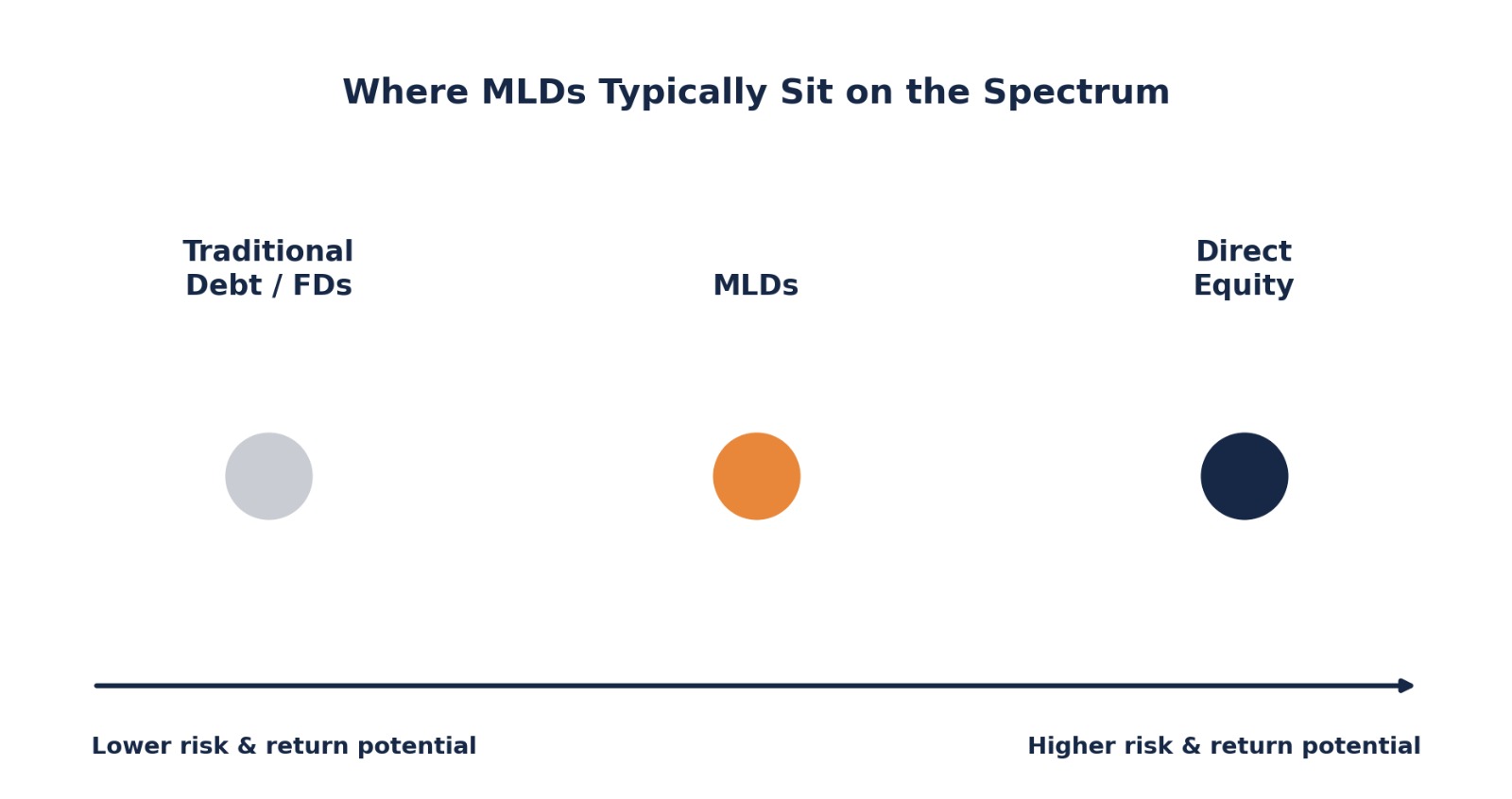
Compared to a fixed deposit or a plain bond, MLDs carry more market-linked variability in their returns, along with the credit risk of the issuer. Compared to direct equity, they typically carry lower volatility, since the debt component is designed to anchor the principal while only the derivative portion is exposed to market movement. This is why they are often positioned as a way to participate in market-linked upside while managing downside risk more deliberately than a direct equity allocation would.
How Are MLDs Taxed in India?
Tax treatment is one of the more distinctive, and frequently misunderstood, aspects of MLDs.
Gains from MLDs are taxed as short-term capital gains of debt, added to the investor’s total income and taxed at their applicable income-tax slab rate, regardless of how long the MLD was held. This makes it important to evaluate MLDs on a post-tax basis, and to factor tax treatment into any comparison against other fixed-income or structured products.
Who Typically Invests in MLDs?
MLDs are generally structured for investors with a moderate-to-high risk appetite who understand market-linked instruments, which is why most issuances are targeted at HNI and UHNI investors rather than the retail mass market. A demat account is required to hold MLDs, and they are typically accessed through a bank, broker, or wealth management firm rather than bought directly off an exchange, at InCred Wealth, our Equity Derivatives desk works alongside investors to structure, evaluate, and access these issuances as part of a broader portfolio plan.
Frequently Asked Questions
1) What is the full form of MLD in finance?
MLD stands for Market Linked Debenture- a Non-Convertible Debenture (NCD) whose payout is linked to the performance of a market index, stock, or other benchmark.
2) Are Market Linked Debentures safe?
MLDs are secured debt instruments, typically backed by a charge on the issuer’s assets. However, “safe” depends on the issuer’s credit rating, the level of principal protection offered, and market conditions at maturity- they are not risk-free.
3) Is the principal guaranteed in an MLD?
It depends on the structure. Some MLDs offer complete principal protection; others offer only partial protection, where capital is at risk beyond a defined fall in the underlying benchmark. Always check the specific term sheet.
4) How are MLDs different from a fixed deposit?
An FD offers a fixed, pre-known interest rate. An MLD’s return depends on the performance of an underlying market benchmark.
5) Who can invest in MLDs in India?
Resident individuals, HUFs, companies, and other eligible investors can invest, typically through a demat account. Most issuances are structured for HNI and UHNI investors given the risk and ticket-size considerations involved.
6) Can I exit an MLD before maturity?
MLDs should generally be treated as hold-to-maturity investments. Some come with a buyback facility from the distributor, or may trade in a limited secondary market, but pre-maturity liquidity should not be assumed.