For investors sitting on surplus cash between two goals, a bonus waiting to be deployed, proceeds from a sale, or money earmarked for six to twelve months out, the usual options are a savings account, a fixed deposit, or a liquid fund.
Arbitrage funds sit in the same conversation, but for a different reason: they are built to behave like debt in terms of volatility, while being taxed like equity. That combination is why they have quietly grown into a ₹3.41 lakh crore category, and it is worth understanding exactly how the strategy earns its return before treating it as a parking spot.
What is an arbitrage fund?
An arbitrage fund is an equity-oriented hybrid mutual fund that profits from short-term price differences between the cash (spot) market and the futures market for the same stock or index, rather than from the direction the stock eventually moves. Because both legs of the trade are taken at the same time, the position is market-neutral, the fund does not care whether the stock goes up or down, only that the gap between its spot and futures price closes as expected by expiry.
How the strategy actually works
In a typical trade, the fund manager buys a stock in the cash market and simultaneously sells its near-month futures contract at a higher price, locking in that premium at the moment the trade is placed. As the futures contract approaches expiry, the spot and futures prices converge, and the fund captures the difference, minus transaction costs, regardless of what happened to the stock price in between.
- Buy: 100 shares of a stock in the cash market at ₹1,000 apiece.
- Sell: one lot of the same stock’s near-month futures at ₹1,008.
- Hold to expiry: spot and futures prices converge; the ₹8 gap (minus costs) becomes the fund’s return on that leg, unaffected by whether the stock actually rose or fell.
This is why arbitrage funds are sometimes described as SEBI-permitted, hedged exposure to equity markets, the fund holds real shares and real futures contracts, but the two positions are structured to cancel out directional risk. SEBI requires these schemes to maintain at least 65% gross equity exposure through such positions to qualify for equity classification.
Why are they taxed like equity funds?
Because arbitrage funds hold the SEBI-mandated 65% equity exposure, they get equity-fund tax treatment even though their risk profile behaves more like a debt instrument. Units held for less than 12 months are taxed as short-term capital gains at 20%, while units held beyond 12 months qualify for long-term capital gains at 12.5%, with the first ₹1.25 lakh of long-term gains in a financial year exempt. This is more favourable than the slab-rate taxation that applies to fixed deposits and most debt fund gains, particularly for investors in higher tax brackets.
What kind of returns can investors expect?
Arbitrage funds are not designed for high growth, the category has delivered average annual returns in the 4–8% range over the last five calendar years, moving with the level of volatility and futures premiums available in the market rather than with equity market direction.
| Metric | 2021 | 2022 | 2023 | 2024 | 2025 |
| Category return (calendar yr) | 4.10% | 4.66% | 7.62% | 8.06% | 6.89% |
A cost to watch: the 2026 STT hike
Budget 2026 raised the Securities Transaction Tax on futures trades from 0.02% to 0.05%. Arbitrage strategies rely on futures transactions for every trade, so this directly narrows the spread the fund manager is trying to capture. The strategy itself has not changed, but the margin it operates on is thinner than before, a reason to moderate return expectations slightly rather than a reason to avoid the category.
Arbitrage funds vs liquid funds vs fixed deposits
The comparison usually comes down to post-tax returns for a given holding period and tax bracket, not headline returns. Using current category averages: an arbitrage fund held for over a year is taxed at 12.5% LTCG, while liquid funds and bank FDs are both taxed at slab rates. For an investor in the 30% tax bracket, that difference in tax treatment, not a difference in the underlying return, is what separates the three options after tax.
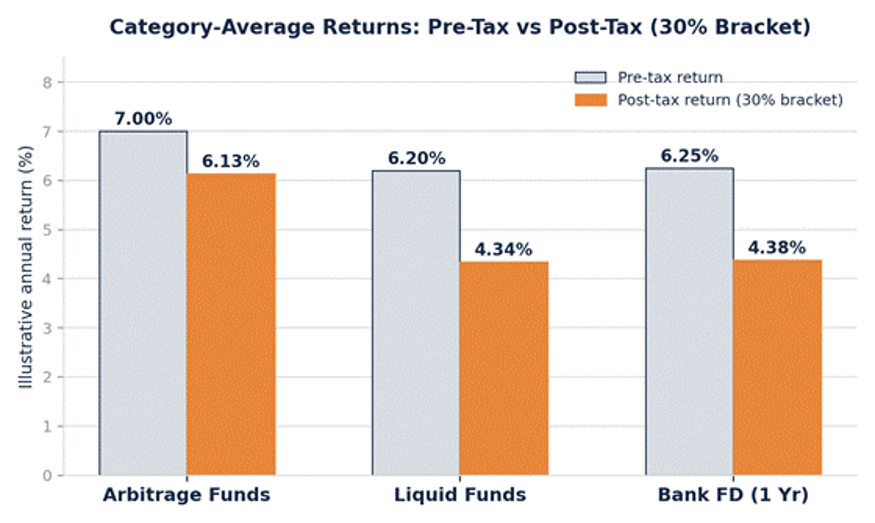
| Category | Typical pre-tax return | Taxation | Approx. post-tax return (30% bracket) | Volatility |
| Arbitrage Funds (category avg.) | ~7.0% | Equity: LTCG 12.5% >1Yr | ~6.1% | Very low |
| Liquid Funds (category avg.) | ~6.2% | Debt: slab rate | ~4.3% | Very low |
| Bank FD (1-year, general public) | ~6.25% | Slab rate | ~4.4% | None (fixed) |
Illustrative, category-level figures as of mid-2026; not scheme-specific. Actual post-tax outcomes depend on your holding period, applicable tax bracket, and the ₹1.25 lakh annual LTCG exemption on equity-oriented funds. Past performance is not indicative of future results.
For shorter holding periods or lower tax brackets, this gap narrows, and the simplicity of an FD or the same-day liquidity of a liquid fund may matter more than the tax edge.
Who should consider them, and the limitations
- Suited to investors parking surplus money for roughly six months to a few years, particularly those in higher tax brackets, rather than those chasing high growth.
- Returns are not guaranteed or fixed the way an FD’s are, they depend on the futures premiums available in the market at the time, which shrink in low-volatility, low-interest-rate phases.
- Very low, but not zero, risk, settlement risk, tracking of the spread, and cost drag (including the recent STT hike) can all trim realised returns versus the theoretical spread.
- Exit loads (typically short redemption windows) mean these are not meant for money you may need back within days or weeks.
The takeaway
Arbitrage funds are not a substitute for equity growth, and they are not risk-free, but for money that needs to sit somewhere for a matter of months to a few years, they offer a rare combination: equity-style taxation with a return and volatility profile that behaves far more like debt. As with any allocation decision, the right fit depends on your holding period, tax bracket, and how that surplus fits into the rest of your portfolio.
At InCred Wealth, allocating to arbitrage funds begins with understanding an investor’s holding period, tax bracket and liquidity needs before deciding how much of a portfolio’s surplus this strategy should hold. Using arbitrage funds well is not simply about finding a low-volatility parking spot, it is about making sure that spot is actually earning its keep, after costs and taxes, for exactly as long as the money needs to sit there.
Sources
Bajaj AMC — Arbitrage Fund Taxation in India 2026
Finnovate — Arbitrage Funds After Budget 2026 STT Hike
Business Standard — Arbitrage fund inflows and AUM, February 2026
Fincart — Arbitrage Fund Taxation India 2026
RightAdvise — Arbitrage Funds India 2026, returns and risk
INDmoney — Arbitrage fund category data, India (2026)
Arthgyaan — Liquid fund category averages, 2026
BankBazaar — SBI Fixed Deposit interest rates, 2026
Arthgyaan — Historical category returns, Hybrid: Arbitrage fundsz