Trade agreements rarely transform economies overnight.
Their significance is often revealed gradually, in investment decisions, supply chains, capital flows and the quiet expansion of economic relationships that compound over decades rather than quarters.
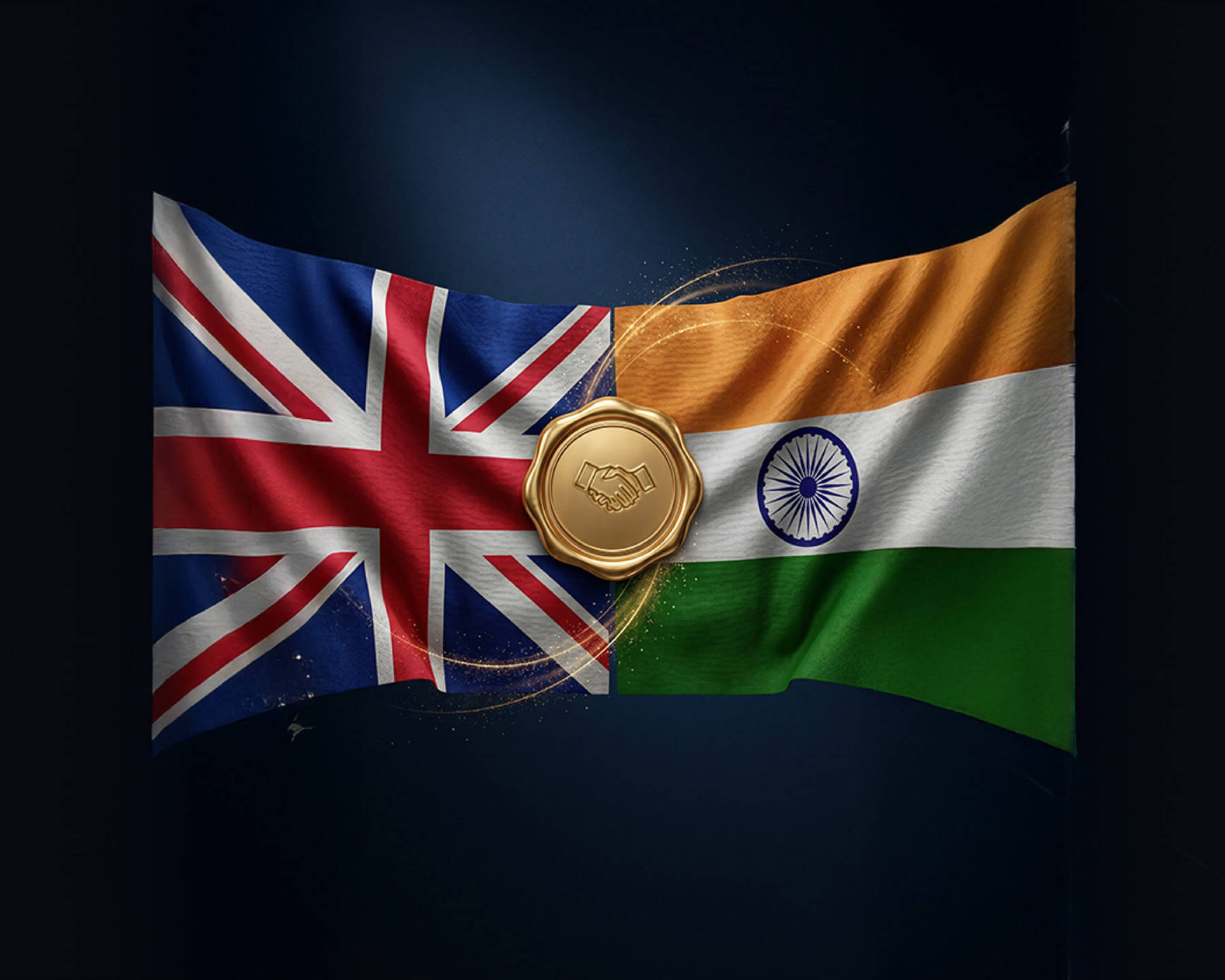
The India-UK Free Trade Agreement, which comes into effect on July 15, is no exception.
Much of the immediate discussion has centred around tariffs and individual sectors. But viewed through a broader lens, the agreement represents something larger: another step in India’s deepening integration with the global economy.
For investors, that distinction matters.
Markets often react to events. Wealth, however, tends to be built around structural trends.
India and the UK: An Established Economic Relationship
Economic ties between India and the United Kingdom extend well beyond merchandise trade. Services, investments, technology and financial linkages have strengthened steadily over the years.
Table 2: India-UK Economic Relationship at a Glance:
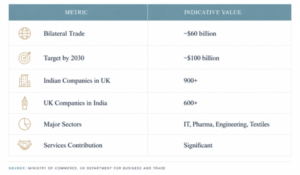
The agreement seeks to deepen these linkages further.
The India-UK Comprehensive Economic and Trade Agreement (CETA) is expected to provide substantial growth across multiple sectors boosting bilateral business.
Which Sectors are expected to benefit?
The benefits of the India-UK Free Trade Agreement, are expected to benefit multiple key sectors:
- Pharma: Approximately 99% of Indian pharmaceutical exports will now qualify for zero tariffs in the UK’s USD 45 billion pharmaceutical market. This is widely viewed as a massive victory for India’s USD 25 billion generic drug industry. Indian pharmaceutical companies will gain highly lucrative access to the UK’s National Health Service (NHS) procurement plan
- Automotive and Auto Ancillary: The agreement opens lucrative export opportunities for Indian auto parts and engines by granting them zero-duty access to the UK market. Additionally, phased reduction of Import Duties on British-manufactured cars, which currently range from 60% to 110%, will be drastically reduced to as low as 10% over a five-year period through a quota-based system, making high-end British carmakers such as JLR consider slashing prices for completely built units (CBUs) imported into India.
- Textiles and Apparels: Indian textiles, clothing, and garments will now attract nil duty in the UK. This crucial change will level the playing field, putting India on par with major competitors like Bangladesh, Pakistan, Vietnam, and Turkey, and allowing Indian companies to compete much more effectively. Industry participants anticipate doubling India’s market share in the UK’s textile and clothing sector from the current 6.7% to at least 12% within the next 3 to 5 years
- Alcoholic Beverages: Import duties on UK products like scotch whisky and gin—which currently face a steep 150% tariff—will be slashed immediately to 75%. Over the next ten years, these tariffs will be further phased down to 40%. This is expected to significantly reduce input costs for manufacturers of “Indian Made Foreign Liquor” too.
- Gems and Jewellery: Gems and jewellery are among the goods that will now enter the UK at zero duty, which will substantially lower costs and improve competitiveness. Specific manufacturing and trade hubs are poised for expansion. For instance, exports of Jaipur’s jewellery (in Rajasthan) are expected to grow due to these reduced tariffs
- IT and IT-enabled Services (ITeS): The agreement will ease mobility, expand market access, and exempt Indian workers from making UK social security contributions for up to 36 months, significantly cutting costs. The exemption will reduce on-site deployment costs for over 900 employers, leading to an estimated saving of ₹4,000 crore across the Indian IT industry. Because the UK accounts for 17% of all Indian IT exports, avoiding these dual payments is expected to directly improve profit margins and sharpen the competitive edge of Tier-I Indian IT firms
The impact of Trade Agreements unfolds gradually, often quietly, and usually over periods longer than market cycles.
Seen through that lens, the India-UK agreement is perhaps less about July 15 itself and more about a broader theme that has been gathering momentum for years, India’s increasing participation in the global economy.
And as with most structural trends, its significance may only become fully apparent in hindsight.
As India’s economic footprint continues to evolve, investors may benefit from periodically reassessing how global opportunities fit within their broader wealth framework.
Description: InCred Wealth and Investment Services Private Limited (“InCred Wealth”), is engaged in the business of distribution of third-party financial products and also acts as a referral agent of third-party financial products and services (“Investment Products”). InCred Wealth does NOT provide investment advisory services in any manner or form. InCred Wealth is an AMFI registered Mutual Fund Distributor & an APMI registered PMS & SIF distributor. Further, this document is not a research report or research recommendation and does not constitute a personal recommendation. Data used above is indicative, compiled from publicly available sources including the Ministry of Commerce & Industry, UK Department for Business and Trade, IMF, World Bank and Bloomberg. Information is for illustrative purposes only and should not be construed as investment advice. Historical trends and projections are not indicative of future performance.