
How evolving investor sophistication is reshaping the boundaries of portfolio construction in India
For years, the Indian investor’s toolkit was elegantly simple: equity mutual funds for growth, debt funds for stability, and fixed deposits for certainty. Today, that toolkit is showing its age.
Spend any time with a serious Indian investor today and you notice something has shifted. The conversations have become more nuanced. Questions about “just market returns” have given way to questions about risk-adjusted outcomes, downside protection, and portfolio resilience across different economic regimes. The investor has grown up, and the products available to them are only beginning to catch up.
This isn’t a niche phenomenon. It’s the natural consequence of a generation of Indian households building meaningful financial wealth, watching markets through multiple cycles, and arriving at a more mature understanding of what portfolios are actually meant to do.
From Savers to Portfolio Thinkers
The first wave of mutual fund adoption in India was largely about participation, getting money into equities and away from the inertia of physical assets. That mission was largely accomplished. The next question, which more investors are asking, is a harder one: now that I’m in the market, how do I build something more intentional?
This shift matters because it changes what investors actually need. A portfolio built purely on long-only equity exposure is, in effect, a single-factor bet , on the market going up. That works beautifully in bull markets, and it has worked well over long Indian market cycles. But investors with larger portfolios, those with specific income needs, or those managing wealth across generations, often need something more considered.
The gap isn’t about greed for higher returns. It’s about wanting portfolios that behave differently under different conditions , that offer some resilience when markets fall, some income when equity is volatile, and some genuine diversification beyond the illusion of it.
The Limits of the Existing Landscape
The traditional structure offered investors two clear paths. Below a certain threshold of wealth, mutual funds , regulated, transparent, accessible , were the sensible choice. Above a certain threshold, Portfolio Management Services (PMS) and Alternative Investment Funds (AIFs) opened the door to more sophisticated strategies, but at the cost of higher minimums and, often, a more opaque relationship with liquidity and risk.
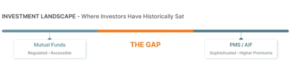
For a growing cohort of investors, neither option fits cleanly. They had moved beyond the entry-level mutual fund experience, but weren’t at the scale where PMS or AIF structures made obvious sense. More importantly, many simply wanted access to more sophisticated strategies , not necessarily higher risk, but more nuanced, within a framework they trusted.
How Investor Needs have Evolved
Understanding this evolution requires looking at how investor priorities change as wealth accumulates and portfolio complexity increases. What begins as a focus on market participation and long-term growth often evolves into a broader focus on risk management, income generation, diversification, and capital preservation.
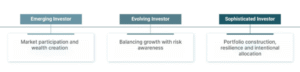
As portfolios grow larger and financial objectives become more diverse, investors increasingly focus on how different strategies interact within a portfolio rather than evaluating investments in isolation. Questions around downside management, diversification, income generation, and consistency of outcomes become as important as return potential.
What SIFs Bring to the Table
SIFs occupy a distinctive space between traditional mutual funds and PMS/AIF structures. They retain the regulatory oversight, transparency, liquidity framework and operational familiarity of mutual funds, while enabling a broader range of investment strategies that were previously available largely through PMSs and AIFs. In doing so, they help bridge the gap between accessibility and sophistication for investors seeking more nuanced portfolio solutions.
With a minimum investment of ₹10 lakh, SIFs create a meaningful middle ground for investors who have outgrown conventional mutual fund exposures but may not require or prefer the higher minimums and structural complexities associated with PMS and AIF offerings.
The types of approaches SIFs can offer include:
- Equity strategies with hedging overlays, designed to participate in upside while managing drawdown risk
- Arbitrage-based approaches that seek returns less correlated to broad market direction
- Active asset allocation strategies that shift positioning based on market conditions
- Income-oriented approaches that prioritise regular distributions over capital appreciation
- Specialist thematic or sector strategies with more focused mandate
None of these is revolutionary in isolation, versions of each exist in the PMS and AIF world. What is meaningful is making them accessible within a structure that carries mutual fund-grade transparency, regulatory reporting, and investor protections.
A Portfolio Construction Lens, not a Product Decision
The right way to think about SIFs, and this is how we’d encourage any investor to approach them, is not as standalone investments to evaluate in isolation, but as potential components in a broader portfolio architecture.
The question isn’t “is this SIF a good product?” The question is “does this strategy complement what my portfolio already does, and does adding it improve my overall risk-return profile?”
For investors with concentrated equity exposure, a hedged equity strategy within the SIF structure might provide genuine diversification. For those in accumulation mode who also have near-term liquidity needs, an income-oriented SIF might serve a specific portfolio function. For investors approaching or in retirement, active asset allocation strategies might offer a degree of downside protection that pure equity mutual funds cannot.
In each case, the value comes from how the strategy fits the whole, not from chasing a category simply because it is new.
The Broader Direction of Travel
SIFs are, in our view, a symptom of something larger: the gradual maturation of Indian investment culture. As more investors accumulate meaningful wealth, as financial literacy deepens, and as market experience accumulates, the demand for more sophisticated, and more intentional, portfolio construction will only grow.
The regulatory response, of which SIFs are one example, is to create structures that meet this demand without sacrificing the investor protections that make the mutual fund framework trustworthy. That is a broadly positive development for the wealth management ecosystem.
For investors, the practical implication is straightforward: the toolkit is expanding. Whether any individual tool belongs in your portfolio is a question that deserves a considered, portfolio-level answer, ideally with an advisor who understands both the strategy and your specific financial situation.
If you would like to explore how strategies may align with your portfolio objectives, the team at InCred Wealth would be happy to engage.
Description: InCred Wealth and Investment Services Private Limited (“InCred Wealth”), is engaged in the business of distribution of third-party financial products and also acts as a referral agent of third-party financial products and services (“Investment Products”). InCred Wealth does NOT provide investment advisory services in any manner or form. InCred Wealth is AMFI registered Mutual Fund Distributor. Further, this document is not a research report or a research recommendation and does not constitute a personal recommendation.