
The value of the Indian Rupee relative to the US Dollar is again in the spotlight. As it nears a new low, fears of imported inflation, higher costs abroad, and macroeconomic stability have once again come to the surface. But currency depreciation, although often painted as negative in the media, can have diverse impacts across industries, assets, and investors.
For long-term investors, particularly high net worth individuals who have increasingly global financial interests, currency movements are not a macroeconomic indicator. They impact portfolio performance, spending power, global investment diversification and asset preservation.
So, the question is not whether the Rupee is depreciating in the short run, but how to prepare a portfolio for currency cycle changes.
Why the Rupee Matters in Portfolio Construction
Currency movements directly affect the real value of wealth. A domestic portfolio may generate attractive nominal returns in Rupee terms, but if global purchasing power declines simultaneously, the effective value of those gains can be lower than assumed.
This becomes particularly relevant for investors with:
- Overseas education goals
- International travel and lifestyle spending
- Global real estate aspirations
- Offshore liabilities or commitments
- Cross-border business interests
- Future succession planning involving multiple jurisdictions
For affluent households, wealth is increasingly measured not only in domestic returns, but in global optionality.
Recent Rupee Trends in Context
Over the last decade, the Rupee has seen a gradual structural depreciation against the US Dollar, interrupted periodically by phases of stability and appreciation. Such moves are not unique to India and are often reflective of broader emerging market currency cycles.
Table 1: Indicative USD/INR Trend
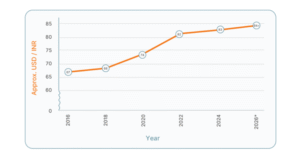
*Indicative market levels for reference purposes.[Text Wrapping Break](Source: RBI Reference Rate Archives, Bloomberg)
While this trend appears significant in isolation, it must also be viewed alongside India’s equity market growth, GDP expansion, rising reserves, and increasing domestic participation in financial assets.
What Drives Rupee Weakness?
Currency valuation is influenced by multiple domestic and international variables. No single factor determines the Rupee’s path.
Table 2: Key Drivers of INR Movement
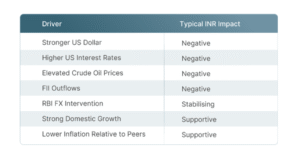
(Source: RBI Monetary Policy Reports, IMF World Economic Outlook, Bloomberg)
In 2026, persistent global rate uncertainty, geopolitical tensions, and commodity volatility continue to shape emerging market currency performance.
Imported Inflation: A Key Domestic Risk
India remains a large importer of crude oil, electronics components, industrial inputs, and precious metals. A weaker Rupee can therefore raise landed costs, which may eventually flow into broader consumer prices.
Table 3: Areas Sensitive to Currency Depreciation
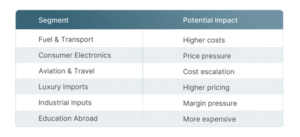
(Source: MOSPI CPI Basket Data, Ministry of Commerce, RBI Bulletin)
For investors, this means nominal wealth growth must be considered alongside inflation-adjusted purchasing power.
Equity Market Impact Is Uneven
Currency weakness does not affect all businesses equally. Some sectors face pressure, while others may benefit.
Table 4: Sectoral Impact of a Weak Rupee
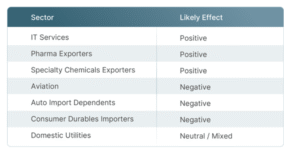
(Source: Bloomberg Sector Earnings Sensitivity Estimates, Company Filings, NSE Data)
Export-oriented businesses earning in Dollars may see translation benefits, while import-reliant sectors may face cost compression.
This reinforces the importance of active portfolio allocation rather than broad-brush market assumptions.
The Case for Global Diversification:
For HNI investors, Rupee weakness often highlights the strategic role of offshore exposure. International diversification is not merely a return-seeking exercise; it can also serve as a currency hedge.
Table 5: Potential Benefits of Global Allocation:
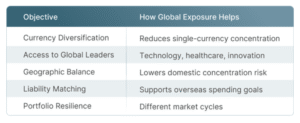
(Source: MSCI Indices, IMF Portfolio Diversification Studies, Bloomberg)
Selective global exposure through regulated structures can complement domestic portfolios, particularly for investors with long-duration wealth goals.
What About Gold?
Gold has historically played a dual role during periods of currency weakness: as a hedge against uncertainty and as a beneficiary of local currency depreciation.
Table 6: Why Gold Gains Relevance During INR Stress :
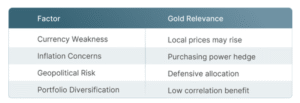
(Source: World Gold Council, Bloomberg)
Gold need not be a dominant allocation, but it can remain a useful strategic diversifier within broader wealth frameworks.
NRI and Global Family Perspective
For NRIs or globally mobile families, Rupee depreciation can create different dynamics.
Table 7: NRI Implications of a Weaker INR
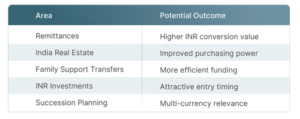
(Source: RBI Remittance Survey, World Bank Migration & Remittances Data)
For such investors, currency cycles often create planning opportunities rather than simple risks.
How High Net Worth Investors May Respond :
Sophisticated investors typically avoid binary reactions to currency headlines. Instead, they reassess structural portfolio positioning.
Key questions may include:
- Does the portfolio have too much exposure to a single region?
- Are future liabilities in a foreign currency?
- Is there adequate exposure to exporters or global themes?
- Is there an inflation hedge in the portfolio?
- Is there capital available to take advantage of risk?
The objective is not to speculate on short-term currency moves, but to ensure resilience across multiple scenarios.
The point is an important one: a weak currency doesn’t necessarily signify a weak economy. Nor does it mean defensive positions.
Investors can adopt a more sustainable approach:
- Domestic growth participation
- Selective global diversification
- Real return orientation
- Currency-aware asset allocation
- Periodic rebalancing
So, a depreciating Rupee might be bad news and good news – depending more on the portfolio rather than the headline itself.
If you are looking to discuss how diversified strategies may fit into your long-term strategy, please reach out to InCred Wealth.
Description: InCred Wealth and Investment Services Private Limited (“InCred Wealth”), is engaged in the business of distribution of third-party financial products and also acts as a referral agent of third-party financial products and services (“Investment Products”). InCred Wealth does NOT provide investment advisory services in any manner or form. InCred Wealth is an AMFI registered Mutual Fund Distributor & an APMI registered PMS & SIF distributor. Further, this document is not a research report or research recommendation and does not constitute a personal recommendation. Data used above is indicative, compiled from publicly available sources including RBI, IMF, World Bank, Bloomberg, Ministry of Commerce, World Gold Council, NSE and company disclosures. Historical trends are for illustrative purposes only and are not indicative of future performance.