In a digitally accelerated and financially sophisticated world, it is easy to assume that markets operate on the basis of data, on policy or sentiment. However, behind the algorithms and asset allocation, there is something more physical, Geography.
Narrow maritime routes are some of the most powerful agents that influence the world markets, and they are not such huge continents or economies. These are narrow lanes, a few miles across, which receive a disproportionate share of the currents of energy in the world. And as pressures build within them, markets far beyond their shores begin to respond.
The Strait Effect – Geography’s Leverage
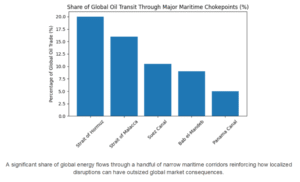
Approximately a fifth of the world oil trade passes via the few essential sea routes every day. One of the most important is the Strait of Hormuz which is a small passageway between major energy producing areas and the international markets.
The strait is the passageway of nearly 20 percent of all of the traded crude oil in the world, along with a substantial portion of the flowing liquefied natural gas, although it is narrow. It is a reminder that most energy security in the world does not lie on expansive terrestrial surfaces, but rather limited passages.
In such corridors, scale works differently. A localized disruption, whether geopolitical tension, military posturing, or shipping risk, can reverberate through commodity exchanges, currency markets, and bond yields within hours.
The Compression of Risk
When physical space is narrow, financial risk becomes concentrated.
Energy markets are particularly sensitive because oil is not merely a commodity; it is a macroeconomic input. It affects transportation costs, manufacturing margins, food prices, airline profitability, and ultimately inflation expectations.
If a strategic waterway faces uncertainty, traders immediately begin pricing in supply risk, even before any actual disruption occurs. Insurance premiums on tankers can rise. Freight rates can spike. Futures curves can steepen. Volatility indices often follow.
The result is what might be called the “Strait Effect”: A geographically confined event creating globally diffused financial consequences.
Markets Move Before Supply Does
Interestingly, physical supply disruptures are not common as opposed to financial responses. Markets are prospective mechanisms. However, it is pricing probability and not reality.
An hour-long area of congestion on one of the key energy corridors might not take one barrel off the street. But then the prices of crude may soar up, the currency of the energy importing countries may depreciate, and the equities markets may turn defensive.
Why?
Since the world economy is a continuum-driven economy. Any perceived weakness in major arteries defeats that supposition.
Inflation’s Invisible Trigger
Energy is among the most sensitive in terms of politics and economics of the global system. A lasting 1015 percent continuous increase in crude prices can trickle to transportation expenses, supply chain and headline inflation measures across continents.
This poses a dilemma to the central banks:
● Tighten policy to contain inflation?
● Look through energy-driven volatility?
Such ambiguity is speedily reacted to, in bond markets. Yield curves adjust. Expectations of a cut in the rate are repriced. This is followed by currency volatility.
In such a way, a small waterway thousands of miles distant, may play a subtle role in the mortgage rates, the overall consumer sentiment, as well as the decisions regarding capital expenditure in other locations.
Strategic Chokepoints in a Multipolar Era
The Strait of Malacca and the Suez Canal provide similar examples of geographic compression translating into economic leverage. Together, a limited number of such chokepoints handle a majority of global maritime energy and trade flows.
As the world evolves toward a more multipolar structure, these corridors take on heightened significance. Not because conflict is inevitable, but because interdependence is.
Globalization has not eliminated geographic vulnerability; it has amplified it.
The Investment Dimension
To investors, the Strait Effect is not as much about the ability to predict individual events rather than being aware of structural sensitivity.
Bouts of high tension along major trade arteries have been associated in the past with:
● Temporary oil price upsurge.
● Power in conventional safe-haven resources.
● Energy and defense related equities outperformance.
● Exchange rate volatility in emerging markets.
Nevertheless, most of these episodes are not always permanent. Risk premiums can squeeze equally fast once uncertainty is stabilized.
The important message is not to be emotional about it but to realize that geographic risk, when highly concentrated, is fueled into diversified portfolios.
Narrow Geography, Broad Implications
In the 21st century, strategic relevance is rarely about territorial size. It is about throughput, of energy, goods, or data.
A strait may appear as a thin line on a map. But economically, it functions as an artery. When arteries narrow, pressure builds. And when pressure builds, markets notice.
The Strait Effect reminds us that even in a digitized financial system, physical geography retains enduring power. Capital may move at the speed of light, yet it remains deeply connected to the movement of ships through water only miles wide.
In an interconnected world, narrow passages can cast long shadows.